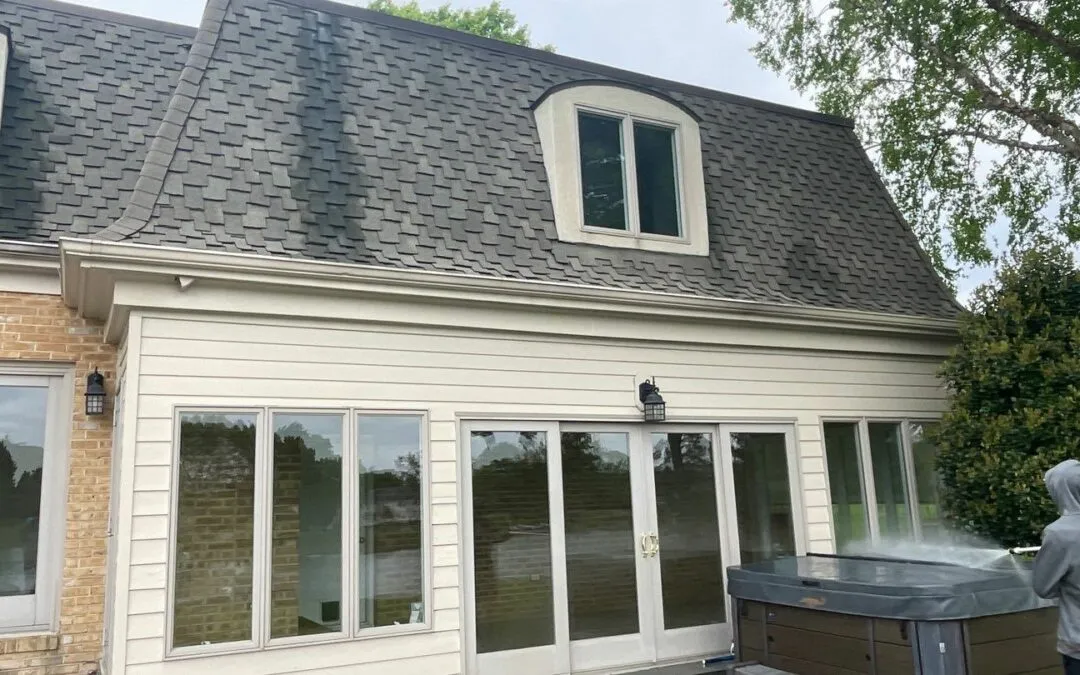
Black streaks on a roof are usually algae, most often a type called Gloeocapsa magma. It feeds on the limestone filler in many asphalt shingles and spreads on the wind from roof to roof. The safe way to remove it is a soft wash: a cleaning solution that kills the algae, followed by a low-pressure rinse. High-pressure washing is the wrong tool because it can strip the granules that protect your shingles.
Why do black streaks show up on some roofs and not others?
Algae needs shade and moisture to grow. That is why streaks usually start on the north side of a roof, under trees, or on slopes that stay damp after rain. Homes near the Chesapeake Bay see a lot of humidity, which gives algae more time to spread. Rain then carries the algae down the roof, which creates the long streak pattern you see from the street.
Once one roof in a neighborhood has algae, the spores travel on the wind to the roofs nearby. That is why you often see several homes on the same street with the same stains.
Are black streaks bad for your roof?
At first, algae is mostly a looks problem. Over time it holds moisture against the shingles and makes room for moss and lichen. Moss grows thicker and can lift the edges of shingles, which lets water get underneath. A stained roof also makes the whole house look older than it is, which matters if you plan to sell.
Why you should not pressure wash a roof
Asphalt shingles are covered in small granules that protect them from the sun. A high-pressure stream can knock those granules loose, and once they are gone the shingle wears out faster. Many shingle makers warn against high-pressure cleaning, so check your roof warranty before anyone points a pressure washer at it.
How soft wash roof cleaning works
A soft wash uses a cleaning solution, not force, to do the work:
- The roof and the plants around the house are checked before work starts.
- The cleaning solution is applied at low pressure to kill algae, moss, and lichen at the root.
- The solution is given time to work.
- The roof is rinsed at low pressure, and nearby plants are rinsed to protect them.
Because the growth is killed instead of blasted off, the roof stays clean longer. Most roofs in our area do well with a cleaning every 2 to 3 years.
Roof cleaning on Kent Island and across Anne Arundel County
All Hands Pressure Washing is a locally owned exterior cleaning company in Stevensville. We soft wash roofs on Kent Island, in Queen Anne’s County, and across Anne Arundel County, including Annapolis, Arnold, and Edgewater. Owner Matt walks you through the process before work starts and takes care to protect your landscaping. One Google reviewer summed it up: “Whitest roof in community.”
- Soft wash roof cleaning, never high pressure on shingles
- Locally owned in Stevensville
- 5-star rating on Google
- Free quotes and a 100% satisfaction guarantee
If your roof has black streaks, moss, or lichen, request a free quote and we will tell you exactly what it needs. Learn more on our roof cleaning page or request a free quote.
Frequently asked questions
Do black streaks mean I need a new roof?
Usually not. Algae sits on the surface of the shingles, and cleaning removes it. If shingles are cracked, curling, or bare of granules, have a roofer inspect them.
Can I clean my roof myself?
You can, but it is risky. A wet roof is slippery, and the wrong pressure or mix can damage shingles and plants. A professional soft wash is safer for you and your roof.
Will roof cleaning hurt my plants?
It should not when it is done right. Plants are rinsed before and after, and the solution is applied at low pressure so it only goes where it is needed.